America – Cradle For The Second Coming Of The
Christ
CHAPTER III
THE WAR OF INDEPENDENCE
"God Works in Mysterious Ways"
The Great Awakening
 The
revival of our national faith, called "The Great Awakening," was triggered by
the anger aroused in the colonists because of the heavy taxation levied on them
by the British Parliament. They called it "taxation without representation."
The Molasses Act of 1764, followed by the Stamp Act and other taxations, were
deeply resented. The
revival of our national faith, called "The Great Awakening," was triggered by
the anger aroused in the colonists because of the heavy taxation levied on them
by the British Parliament. They called it "taxation without representation."
The Molasses Act of 1764, followed by the Stamp Act and other taxations, were
deeply resented.
Because many settlers wanted to seek new farmland, the
British Ordinance of 1763 restricting Western settlement also aroused great
indignation.
By 1775, the restrictions regarding western settlement and
the revenueraising acts by the British Parliament, though they provoked great
ire, also created a sense of unity among the colonies. This unity
helped foster resistance against the expanding power of the British Parliament
and showed once again how "God works in mysterious ways His wonders to
perform."
When the time of crisis came, the colonists were ready. That
decisive turn came in April, 1775, when the Revolutionary War really began. It
would not end until 1783.
The Declaration of Independence
More than a year of fighting followed the critical juncture
of 1775 before the colonies could formally agree to break their ties with
Britain. But on July 4th, 1776, the thirteen colonies, united as a federation
of states, issued a unanimous declaration,The Declaration of Independence. It
begins:
We hold these truths to be selfevident: that all men are
created equal; that they are endowed by their creator with certain inalienable
rights. That among these are life, liberty, and the pursuit of happiness. That
to secure these rights...
And for the support of this declaration, with firm
reliance on the protection of divine Providence, we mutually pledge to each
other our lives, our fortunes, and our sacred honor.
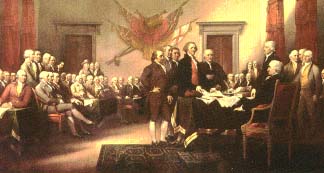
Signing the Declaration of
Independence
All fifty-six Americans who signed the Declaration of
Independence risked death by hangingif their revolution failed. They risked
sharing the fate of the courageous patriot, Nathan Hale, who was hanged without
trial, and who, on the gallows, spoke the famous words: "I only regret that I
have but one life to lose for my country." What inspiring courage!
Note the fervor of patriotism and love for their new country
expressed in the mutual pledge: "to each other our lives, our fortunes, and our
sacred honor." These men meant it! They followed through! Many lost their
lives, many lost property, and many endured terrible suffering.
John Hancock, whose elaborate signaturebold and large "so
that even George III cannot miss it"heads those affixed to the Declaration,
later lost much of his fortune in the war, but fortunately escaped when General
Gage sent troops to Lexington and Concord to effect his capture.
The holy dedication of all the signers, in the face of such
great risk, is echoed in Jefferson' forceful declaration, "I swear,
before the altar of God, eternal hostility to every form of tyranny over the
mind of man."
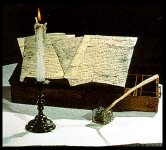
The Declaration's salient words, "endowed by
their creator with certain inalienable rights," would profoundly
affect the history of mankind.
 Our forefathers understood that it was
God, not man, who was responsible for supplying them with
rights. And we today should never for an instant forget to be thankful that
they believed in those rights enough to fight for
them. Our forefathers understood that it was
God, not man, who was responsible for supplying them with
rights. And we today should never for an instant forget to be thankful that
they believed in those rights enough to fight for
them.
As so clearly stated in the Declaration, the
colonists fought the Revolutionary War with a firm reliance on divine
Providence. General George Washington believed that the only way they could win
this war was with God's help. In line with the highest spiritual understanding
of that time, he issued orders to his troops demanding (along with other
highprincipled behavior) "punctual attendance at divine services to implore the
blessings of heaven upon the means used for our safety and defense."
Surely, "God tempers the wind to the shorn lamb," for it was
only through the most miraculous intervention of divine Providence that the
ragged and tattered little band, "the continental army" led by General
Washington, survived and eventually won.
Memoir of Major Ben Tallmadge
An illustration of this divine protection occurred early in
the struggle for independence: At about the same time the Declaration of
Independence was being signed, the British general, William Howell, had a
welldisciplined fighting force of over 32,000 troops. Washington had barely
8,000, pitifully few of them trained. The Americans were gathered near the town
of Brooklyn on the western end of Long Island. The British moved in with their
32,000 troops, and by August 27, 1776 our entire Continental Army was
surrounded.
At this pointand there can be no doubt that it was the
result of providential interventionGeneral Howell did not attack for two whole
days. Had he attacked, the war would have been over. Obviously the prayers of
General Washington and his men had been effective.
For the Continental Army to fight under these conditions
would have been suicide; to surrender was unthinkable. The only other way was
to transport 8,000 men across the East River, more than a mile wide, without
the British detecting the operation.
That night, as they crossed the East River in small boats,
not a sound was heard. But time was against them. Many were still on the
Brooklyn side when the sun began to rise, which meant potential death for the
Americans who had not yet crossed.
Major Ben Tallmadge, one of General Washington's officers
there that morning, described what happened:
As the dawn of the next day approached, those of us who
remained in the trenches became very anxious for our own safety; and when the
dawn appeared there were several regiments still on duty.
At this time a very dense fog began to rise (out of the
ground and across the river) and it seemed to settle in a peculiar manner over
both encampments.... So very dense was the atmosphere that I could scarcely
discern a man six yards distance. [The fog remained long after] the sun had
risen. (Major Benjamin Tallmadge, Memoir, pp. 1214)
When the last man, horse, artillery and General Washington
had safely crossed, the fog lifted. Washington and his men knelt in prayer to
thank God for this blessing from heaven.
Before the war ended, many more similar instances of answers
to fervent prayer were recorded in diaries and documents. They were called
"providential acts of God." Christian Scientists would call them
"demonstrations." It was all part of divine Love's plan to provide the cradle
for the second coming of the Christ, the impersonal Christ, and its permanent
establishment as the kingdom of God in the consciousness of humanity.
Valley Forge
As CommanderinChief of the Continental "army," it fell to
George Washington to turn farmers, traders, merchants, seamen, frontiersmen and
even young boys into soldiers. Because the Federation had no power to collect
taxes or raise an army, Washington's soldiers, all volunteers, often furnished
their own clothing, their own rifles and sometimes even their own
gunpowder.
The world owes much to these libertyloving Christian
patriots who, in their cry "Give me liberty, or give me death!" were sustained
by faith and prayer. Their endurance as they fought on multiple fronts unfolds
in a saga of persistence in the face of incredible hardships.
Consider the snowandicecovered Valley Forge retreat. There,
supported and strengthened by daily prayer, Washington's men, without boots or
warm clothing4000 of them sick from exposure to cold, hunger, and
diseasesurvived a long savage winter.
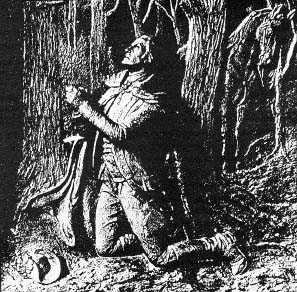
George Washington The Prayer at Valley
Forge
"The event is in the hands of
God."
Sharing the fate of his small ragged
army, whose endurance and courage defied a king and built a nation, Washington
kneels at prayer in the woods at Valley Forge.
At Valley Forge many died of malnutrition and of the cruel,
unrelenting cold that wrapped its icy arms around the tattered regiment. The
faith of the ragged, decimated survivors rested in that ultimate reality whose
sustaining power and ordered activity has mercifully provided continual
guidance over human destiny.
"Freezing, starving, dying," wrote a 19th Century historian,
"they perseveredthey kept the faith. In this testing fire for freedom [they]
were forged into men of steel. Their iron will to endure helped them to
survive."
"The Event is in the Hands of God"
General Washington shared the hardships of his small ragged
patriot army, struggling alongside them in every difficulty. He also shared
their indomitable faith. It was his practice, when faced with no evident
human solution, to go into the woods to pray. Then, Washington
said, "The event is in the hands of God."
When the frustrating eightyearlong war ended on October 19,
1783, Washington made sure a peace treaty between all warring factions was
signed by Congress. He wrote to the governors of the independent states of
America, congratulating them "on the glorious events which Heaven has been
pleased to produce in our favor." He then announced his retirement and called a
final review of his troops to say a fond farewell.
Jan Pierce records: "The love and loyalty which flowed back
and forth from general to soldier, at the parade, was an emotional time. In
bidding 'Adieu' to his officers, he asked each of them to come and shake his
hand. They soon forgot their formal occasion and hugged and cried without
shame."
Of Washington's character, Henry A. Brown wrote:
Modest in the midst of Pride; Wise in the midst of
Folly; Calm in the midst of passion; Cheerful in the midst of Gloom; Steadfast
among the Wavering; Hopeful among the Despondent; Bold among the Timid; Prudent
among the Rash; Generous among the Selfish; True among the Faithless; Greatest
among Men and Best among the Great....
It is a measure of George Washington's greatness that he
glimpsed the import of the task he and his army had undertaken. During the
bitter Valley Forge winter he had written:
Even if the rest of the world continues to ignore us,
we will fight on. For we are fighting not only for ourselves, but for all
mankind. We are fighting for freedom and human dignity and the right to worship
the God of our choice.
The tremendous moral consequences of the ideals of liberty
and democracy that brought on the American Revolution are by nature
incalculable. So is our debt to the brave heroes who risked their lives to
advance these ideals, from the first signer of the Declaration of
Independence to the last farm lad wounded in battle.
These patriots knew that a redeeming Providence presided
over the rise and fall of civilizations, and they firmly believed that the help
they implored of God would be forthcoming. Their faith, courage and endurance
defied a king and built a nation. Yes, a nation that would provide the cradle
for the second coming of the Christ, which, in turn, would set at liberty every
human being not only in America but in all the worldshowing them that "the
kingdom of God is within" their own consciousness.
AMERICA book sections
Foreword | I |
II | III |
IV | V |
VI | VII |
VIII | IX |
X | XI |
XII | XIII |
Conclusion | Bibliography |