America – Cradle For The Second Coming Of The
Christ
Chapter II
How America Became The Cradle For the
Second Coming of the Christ
Puritans Become Pilgrims
 One of
the least materialistic and therefore most persecuted religious groups in
England during the early 1600's was the Puritans. Why were they called
Puritans? They were called Puritans because they hoped to restore Christianity
to its "ancient purity." Because they sought to separate themselves from the
temptations of the world, some of them came to be called "Separatists." One of
the least materialistic and therefore most persecuted religious groups in
England during the early 1600's was the Puritans. Why were they called
Puritans? They were called Puritans because they hoped to restore Christianity
to its "ancient purity." Because they sought to separate themselves from the
temptations of the world, some of them came to be called "Separatists."
Hoping to find a place where they could worship without fear
of persecution, a group of Puritan Separatists took temporary refuge in
Holland. Among the Dutch the persecution was less, but these Puritans found
themselves still surrounded by secular pressures and temptations. After a short
time, perhaps a dozen years, they decided to move to the New World to America,
the vast land across the Atlantic Ocean journey of faith that would earn them
the name Pilgrims.
The Pilgrims Leave Holland
For the voyage back to England the Pilgrims purchased a
small ship named Speedwell. It is interesting to note that "Speedwell" is a
common name for the flower "Veronica" which is connected with the legends of
St. Veronica, who was believed to have wiped the face of Jesus on his way to
the cross, receiving the imprint of his face on her kerchief.
A "chronicle of those memorable circumstances of the year
1620, as recorded by Nathaniel Morton, keeper of the records of Plymouth
Colony, based on the account of William Bradford, sometime governor thereof"
describes the Pilgrim's departure from Holland on the first leg of their
voyage:
So they left that goodly and pleasant city of Leyden,
which had been their resting place for above eleven years, but they knew that
they were pilgrims and strangers here below, and looked not much on these
things, but lifted up their eyes to Heaven, their dearest country, where God
hath prepared for them a city (Heb. XI, 16), and therein quieted their
spirits.
When they came to Delfs-Haven they found the ship and
all things ready, and such of their friends as could not come with them
followed after them, and sundry came from Amsterdam to see them shipt, and to
take their leaves of them. One night was spent with little sleep with the most,
but with friendly entertainment and Christian discourse, and other real
expressions of true Christian love.
The next day they went on board, and their friends with
them, where truly doleful was the sight of that sad and mournful parting, to
hear what sighs and sobs and prayers did sound amongst them; what tears
did gush from every eye, and pithy speeches pierced each other's heart, that
sundry of the Dutch strangers that stood on the Key as spectators could not
refrain from tears. But the tide (which stays for no man) calling them away,
that were thus loath to depart, their Reverend Pastor, falling down on his
knees, and they all with him, with watery cheeks commended them with the most
fervent prayers unto the Lord and His blessing; and then with mutual embraces
and many tears they took their leaves one of another, which proved to be the
last leave to many of them.
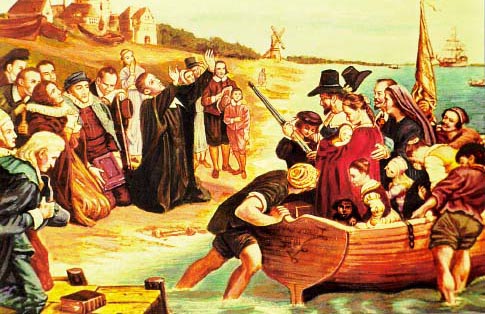
The Pilgrim's tearful departure from
Holland
Farewell to England
The good ship Speedwell carried its passengers safely back
to England where they assembled in July of 1620 to make their final plans for
the daring venture. At the insistence of the financial backers of the voyage,
the Pilgrims were joined by other farmers and tradesmen, who also sought a
better life in America. A second ship, the Mayflower, was acquired and William
Bradford became the group's leader. When all was ready the Pilgrims boarded two
ships, but it quickly became obvious that the Speedwell was not seaworthy for
the longer trip to America. It leaked so badly it had to be abandoned, and its
passengers crowded onto the Mayflower.
On September 16th, 1620, the Mayflower, crammed with 102
Pilgrims and other passengers seeking a new life in America, sailed from
Plymouth, England "into the pages of history."
The departure caused little stir. Great things often happen
when we do not realize it. One night angels sang over the Bethlehem hillsides
and only a few shepherds heard it and were led to the stable where Jesus was
born. Centuries later in 1775, when Paul Revere set out on his midnight ride,
who knew that "the fate of the nation was riding that night?" Just so, in 1620,
when the Mayflower pulled away from English shores, no one knew that a
new era was beginning.
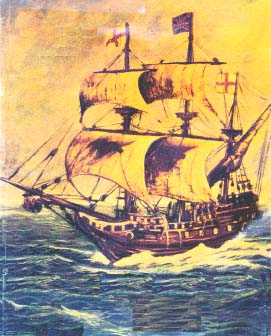
The Crossing
The horrible overcrowding of the small Mayflower made the
Atlantic crossing a nightmare. Midway across the Atlantic the Mayflower was
engulfed in a storm that terribly threatened the vessel. Huge waves tossed the
boat about, heaving and writhing under shrieking, screaming winds that
threatened to tear the masts from the deck. Seasick passengers shivered below
decks, wondering if the gigantic waves would topple the ship.
"He who hesitates is lost," says the old adage. At this
moment, considering the trials they endured and those still ahead, the Pilgrims
might have been tempted to say, "He who hesitates is probably right." But
the Pilgrims did not hesitate. The Mayflower sailed on and the fate of
a nation, the destiny of untold millions yet unborn, sailed with them.
Land!
On November 19, 1620, a shout went up: "Land!" Everyone
rushed on deck. Barely visible many miles away a strip of shoreline could be
seen. The Pilgrims dropped to their knees and wept with joy, thanking God.
After sixty-six days and nights on the Atlantic, God had delivered them to the
New World.
Two days later the vessel reached Provincetown Bay in
Massachusetts. As the ship found its way to the vast bay and dropped anchor the
Pilgrims saw stretching before them a dark forbidding wall of forest.
As the icy winds of winter swept down from the north, the
weary voyagers discovered that the two-month voyage of rough seas and bitter
winds had taken them far north of their expected destination in the Virginia
colonies. They were far from home, with no one to greet them, no friendly house
to enter. As Nathaniel Morton's chronicle describes the scene:
Being now passed the vast ocean, and a sea of troubles
before them in expectations, they had now no friends to welcome them, no inns
to entertain or refresh them, no houses, or much less towns, to repair unto to
seek for succour; and for the season it was winter, and they that know the
winters of the country know them to be sharp and violent, subject to cruel and
fierce storms, dangerous to travel to known places, much more to search unknown
coasts.
Besides, what could they see but a hideous and desolate
wilderness, full of wilde beasts and wilde men? and what multitudes of them
there were they knew not: for which way soever they turned their eyes (save
upward to Heaven) they could have but little solace or content in respect of
any outward object; for summer being ended, all things stand in appearance with
a weatherbeaten face, and the whole country, full of woods and thickets,
represented a wild and savage hew.
If they looked behind them, there was a mighty ocean
which they had passed, and was now as a main bar or gulch to separate them from
all civil parts of the world.
Some of the party wanted to continue south but they were
overruled; these visionary pioneers had an appointment with destiny and they
stood fast.
The Mayflower Compact
The 102 settlers aboard the Mayflower hold a rightly revered
place in the history of America. Before disembarking, before even setting foot
on the new land, these settlers blazed a new trail in participatory government,
a trail that would guide a new nation toward democracy.
On November 21, 1620, the Pilgrims and other colonists met
in the cabin of the ship and forty-one men signed an agreement that became
known as the Mayflower Compact. This was the earliest attempt at
self-government in the New World. (Because women had few legal rights in those
days, only men signed the Compact.) The forty-one signers, in eight
sentences, brought to flower the religious and political thinking of
generations when they agreed to elect men to rule over them whom they would, by
consent, obey. This was the first little step toward the Constitution of the
United States of America.
The Vision of the Pilgrims
Question: What vision guided the Pilgrims aboard the
Mayflower when 379 years ago they landed in America? What was it that
brought them to the shores of the New World?
Answer: Divine Love was preparing a place for the
second coming of the Christ.
The Pilgrims had a vision of hope, a vision of freedom. They
hoped to form a nation where the government would be established according to
the Scriptures.
They had endured much and had a fair understanding of how
they wished to apply their understanding of Scripture to many situations,
including civil government.
William Bradford, second governor of the Plymouth Colony,
wrote in his diary:
A great hope and inward zeal they had of laying some
good foundation for the propagating and advancing the gospel of the Kingdom of
Christ in those remote parts of the world; yea, though they should be but even
as steppingstones unto others for the performing of so great a work.
(William Bradford, History of Plymouth Plantation: 16061646 ed.
William T. Davis, p. 46)
Verily, they were a "stepping stone" to
the eventual founding in human consciousness of the second coming of the
Christ, when they drew up and signed the document today called the Mayflower
Compact.
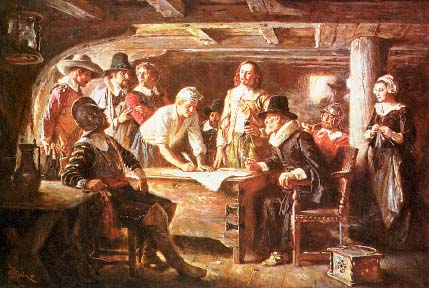
Signing of the Mayflower Compact,
1620
Artist: Percy Moran
Courtesy of
the Pilgrim Hall Museum, Plymouth, Mass.
Their Mayflower Compact, signed Nov. 21, 1620, before
the settlers even stepped ashore at Plymouth Rock, reads:
"In the name of God, Amen. We whose names are
underwritten....having undertaken for THE GLORY OF GOD AND ADVANCEMENT OF THE
CHRISTIAN FAITH...a Voyage to plant the first Colony....Do by these
Presents, solemnly and mutually, in the presence of God and of one another,
covenant and combine ourselves into a civil body Politick....In Witness whereof
we have hereunto subscribed our names at Cape Cod, the eleventh of
November...Anno Domini 1620."
The Mayflower Compact constituted the signers and
their families as a body politic. In eight short sentences it made a covenant
with God and each other to found a colony for His glory. The eventual outgrowth
of this little seed of Christian faith, called the Mayflower Compact,
would be the United States Constitution with laws that would
ensure liberty and freedom of religion for all.
These freedoms could only come about because God's
Constitution is always unfolding. The Mayflower Compact was one
step. Another would occur in 1787 when a good example of God's
Constitution would be given word--words which like the Bible's can do
no more for mortals "than can moonbeams to melt a river of ice" without the
spiritual background and spiritual trust in good.
Guided by the hand of infinite good, the Pilgrims were
helping prepare the needed spiritual background for the second coming of the
Christ. Even their seeming misfortunes were part of the plan of divine Mind.
The Pilgrims came to the new colonies to spread the gospel; by divine
intervention they were blown off course. Had they reached the destination
man willed for them they would never have enjoyed the
religious or civic liberty God had planned for them, since the Virginia colony
had its roots deep in the hierarchical, monarch-led Church of England. Had they
not been forced to face the wilderness relying only on each other they might
never have written the Mayflower Compact. An "indispensable step" would
have been lost.
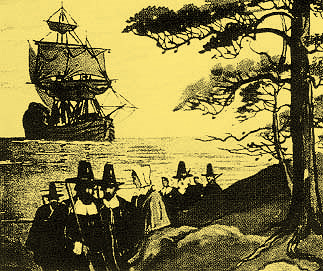
The Pilgrims Land
Following the signing of the Mayflower Compact, the
weary voyagers sent out scouting parties along the coast, looking for a good
place to settle. On December 21, 1620, the Pilgrims reached Plymouth and on
December 30 a boatload of Pilgrims climbed off the ship and stepped onto
Plymouth soil. Only curious Indians lurked in the woods. Snow swirled at the
Pilgrims' feet, and the land looked hostile and desolate as icy winds howled in
the bare trees.
The Pilgrims' first act in the New World was to give thanks.
William Bradford, describing the first landing of the Mayflower at Plymouth
that December, writes:
Being thus arrived in a good harbor, and brought safe
to land, they fell upon their knees and blessed the God of Heaven who had
brought them over the vast and furious ocean, and delivered them from the
perils and miseries thereof, again to set their feet on the firm and stable
earth.... What could they see but a hideous and desolate wilderness, full of
wild beasts and wild men--and what multitudes there might be of them they knew
not. The season it was winter, sharp and violent, subject to cruel and fierce
storms. What could now sustain them but the Spirit of God and His
grace?
Of the Pilgrims' landing Mary Baker Eddy writes:
On shores of solitude, at Plymouth Rock, they planted a
nation's heart,the rights of conscience, imperishable glory. No dream of
avarice or ambition broke their exalted purpose, theirs was the wish to reign
in hope's reality--the realm of Love. (Pul. 10:10)
When first the Pilgrims planted their feet on Plymouth
Rock, frozen ritual and creed should forever have melted away in the fire of
love which came down from heaven.
The Pilgrims came to establish a nation in true
freedom, in the rights of conscience. (Mis. 176:20)
Perhaps some readers of this book will remember memorizing
(in grade school) Felicia Heman's poem, regarding the Pilgrims' landing:
And the heavy night hung dark
The hills and waters o'er,
When a band of exiles
moored their bark
On the wild New England shore
Aye, call it holy
ground,
The soil where first they trod!
They have left unstained what
there they found
Freedom to worship God!
The Bitter First Winter
The settler's first winter in the New World was a saga of
terrible suffering. When the Pilgrims arrived at Plymouth in December, many
were sick. The few able bodied among them had to build huts. Rowing from the
Mayflower to shore they had to wade the last few yards through frigid
waters. In wet wool and canvas clothing they labored on the frozen, snow
covered ground from dawn till dark, cutting trees for log huts. Gradually the
Pilgrims moved from the cold Mayflower into these even colder log
huts.
Food was scarce. Nearly half of the Pilgrims, including
their first governor, John Carver, died of cold, disease or malnutrition. The
other half were so weakened by hunger they scarcely had the strength to bury
the dead. This must have stunned and demoralized at least some of these valiant
Pilgrims.
The Pilgrims also lived in terror of being attacked by the
Indians with whom they had not yet become friendly. They buried their dead at
night so the Indians wouldn't become aware of how few Pilgrims were left, as
they feared this might encourage the Indians to attack. (The Indians had ample
reason to hate Europeans, but that is another story.)
Samoset and Squanto
At last, in March of 1621, the Pilgrims' steadfast trust in
God was rewarded. An Indian named Samoset visited the
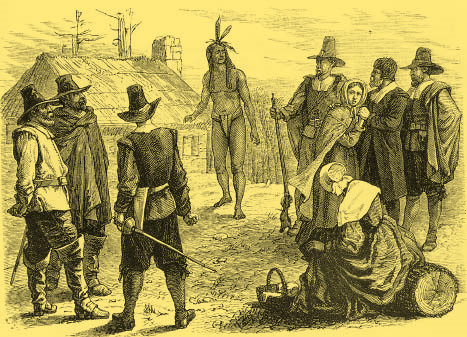 Pilgrims. He had learned a few words of English from English sea
captains with whom he had traded goods, and had even sailed with them on their
ships. Pilgrims. He had learned a few words of English from English sea
captains with whom he had traded goods, and had even sailed with them on their
ships.
Samoset brought the settlers an invaluable blessing; he
introduced them to Squanto, an Indian who had lived in England and understood
the newcomers' language and ways. Squanto took compassion on the settlers, even
though he himself once had been enslaved by their countrymen. He gave the
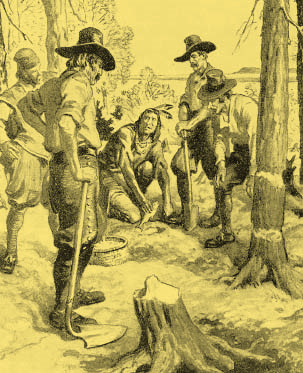
Pilgrims corn and helped them plant it. He taught the colonists how to grow
other crops, and how to hunt and fish.
Samoset befriends the Puritans
Survival was the major issue of that first year, but with
Squanto's help the Pilgrims hung on until the fall crops brought in a good
harvest.
The First Thanksgiving
In autumn of 1621, with another winter approaching, instead
of begging God for more blessing, the Pilgrims'
 profound
faith in God led Governor William Bradford to set aside a day for public
Thanksgiving in gratitude for the blessings already received. The Pilgrims were
heeding the many Bible references to the importance of "thanksgiving." profound
faith in God led Governor William Bradford to set aside a day for public
Thanksgiving in gratitude for the blessings already received. The Pilgrims were
heeding the many Bible references to the importance of "thanksgiving."
History tells us that Chief Massosoit was invited. He
brought 60 braves, 5 dressed deer and a dozen wild turkeys. Even popcorn helped
to celebrate this first great Thanksgiving Day, which lasted three whole days,
so deep felt and abounding was their gratitude to God.
Squanto helped the Pilgrims survive their first grim years
at Plymouth Colony. His wonderful work with the Pilgrims brought a relationship
of peace and helpfulness between the settlers and the Indians that would last
more than fifty years.
Squanto shows Puritans how to plant
crops.
Seeking freedom of the spirit, the Pilgrims courageously
carved a home out of what must have seemed a fierce, ruthless, ferocious,
unyielding, relentless and forbidding territory, that the Bible (Rev.
12:6) calls "the wilderness" that "the woman fled into," in fulfillment of
prophecy. (See S&H 565:29.)
The Mayflower brought a wonderful breed of human beings to
America. Longfellow in his poem about Miles Standish, writes, "God sifted out a
hundred and two seeds from the civilization of Europe to plant a new nation on
these shores."
What did they come for?
The Pilgrims came for one purpose--the propagation of the
gospel. The Mayflower's passengers were just middle-class people--unpretentious
tradesmen, farmers and laborers--but they were strong, rugged, and determined.
Far from home, put out in icy November with no houses, no food, and with the
specter of fearsome Indians and wild animals hiding in the woods, they
made it. No one should sneer at the rugged individualism that built
this country and the rugged way this country was founded.
The Pilgrims created a path for all to follow. Many years
later William Bradford said, "As one small candle may light a thousand, so the
life here kindled (in Plymouth) hath shown unto many, yea, in some sort, to our
whole nation." Thus did this sturdy remnant "on shores of solitude...plant a
nation's heart--the rights of conscience, imperishable glory...their's was the
wish to reign in hope's reality--the realm of Love."
The New England Federation
America is unique. It was divinely founded to make mankind
ready for the second coming of the Christ.
The Pilgrims were just one small settlement of many that
would spring up in America, drawn by the desire to worship according to the
dictates of their own conscience. The details of their faith and their
understanding of God, infinite good, varied, but each colony had a desire for
"the furtherance of so noble a work, which may by the providence of Almighty
God hereafter tend to the glory of His divine Majesty" (Documents of
American History, p.8).
The documents establishing the governments of these early
settlements always began in a manner showing their distinctive Christian
character, such as: "Forasmuch as it has pleased the Almighty God by the wise
disposition of His divine providence...to maintain and preserve the liberty and
purity of the Gospel of our Lord Jesus [Christ]...which according to the truth
of the said Gospel is now practiced among us..." (Ibid. "Fundamental Orders of
Connecticut," Jan. 14, 1639).
On May 19, 1643, several of the colonies decided to get
together and draw up a document they called The New England
Federation.
What did these colonies all have in common? Most of the
published material coming out of early America spoke clearly of God, Christ
Jesus, and the Holy Spirit. Their basis was I Cor. 3:11:
"For other foundations can no man lay than that is laid,
which is Jesus Christ."
Whereas we all came into these parts of America with one
and the same end and aim, namely: to advance the Kingdom of our Lord Jesus
Christ, and to enjoy the liberties of the Gospel in purity, with
peace....
These liberties didn't come all at once. Much was learned
the hard way. An example was the Pilgrims' experiment with communal farming,
which caused them to almost starve during the first two years.
Facing their third year of starvation, the elders of
Plymouth demanded the institution of a biblically based free enterprise system
in order to prevent the total destruction of their colony.
Governor Bradford tells us in his Diary that "this
made all hands very industrious, and gave far better content...."
This solution to poverty was another beacon pointing the
way. In Bradford's words: "As one small candle may light a thousand so the
light kindled here has shown unto many, yea, in some sort, to our whole nation"
(History of Plymouth Plantation).
That light did keep on shining, and the nation kept growing
and prospering. As Saint Francis of Assisi advised: "Start by doing what's
necessary, then what's possible, and suddenly you are doing the
impossible."
By 1732 America was made up of thirteen colonies. During
this first century God had blessed the colonies beyond measure. Then like a
slowly dying fire the spiritual light and faith began to dim. By the mid 1700's
what had been a blazing light had become only a faint glow. Had prosperity made
them forget God? It took the breath of God's spirit to revive our national
faith--to cause an awakening.
AMERICA book sections
Foreword | I |
II | III |
IV | V |
VI | VII |
VIII | IX |
X | XI |
XII | XIII |
Conclusion | Bibliography |